

Conflict is normal. Even healthy couples snap, misread each other, or say something sharper than they meant. The goal is not a fight-free marriage. It is learning how to repair and reconnect after a fight, because repair rebuilds emotional safety, trust, and closeness over time.
If you have ever thought, “I do not even know what to say now,” this repair roadmap is for you. Use it as a simple path back to each other after the tension spikes.
Reconnect After a Fight: The 5-Step Repair Roadmap
- Cool down first
- Reopen the connection with a reset line
- Apologize without defending
- Address the pattern (if it is the same fight again)
- Rebuild emotional safety with a next-step plan
Let’s walk through each step with real phrases you can borrow.
Step 1: Cool Down First (because repair cannot happen in a heat wave)
When emotions are high, your brain is busy protecting you, not connecting with your spouse. Trying to force a perfect conversation mid-argument usually backfires.
What to say (simple, calming, and specific):
- “I want to do this well, and I’m too heated right now. Can we take a 20-minute break?”
- “I’m starting to get defensive. I need a pause so I don’t say something I regret.”
- “I’m not walking away from you. I’m stepping back so we can come back better.”
What not to say (if you can help it):
- “Whatever.”
- “I’m done.”
- “You always do this.”
Quick tip: If you ask for a break, suggest a time to come back. That time limit communicates commitment, not avoidance.
Check out our resource on the DEARMAN Method.
Here’s another helpful resource from The Gottman Institute on repair attempts or de-escalation.
Step 2: Reopen the Connection with a Reset Line (your “we are on the same team” moment)
After cooling down, most couples need a gentle doorway back in. This is where a reset line works wonders. It is not a full discussion yet. It is a re-entry. A reset line gives you a simple bridge to reconnect after a fight.
Reset lines that lower the temperature:
- “Can we start over?”
- “I don’t want to be against you. I want to be with you.”
- “I’m sorry we got sideways. I care more about us than being right.”
- “I love you. I’m ready to try again.”
If one of you still feels guarded, use a gentler approach:
- “I know I hurt you. I’m listening.”
- “Can you tell me what that felt like for you?”
Step 3: Apologize without Defending (the fastest bridge back to closeness)
Many apologies fail because they include a hidden argument. Emotional connection grows when someone takes ownership without trying to win the case.
A strong repair apology has 3 parts:
- What I did (specific)
- The impact (how it landed)
- The change (what I will do differently)
Use these examples as templates:
- “I raised my voice. I can see that felt harsh and unsafe. I’m sorry. I’m going to slow down and speak more calmly.”
- “I shut down and went quiet. That probably felt like I didn’t care. I do care. I’m sorry. Next time I’ll tell you I need a minute instead of disappearing.”
- “I used sarcasm. I know that stings. I’m sorry. I want to be kind, even when I’m frustrated.”
- “I interrupted you. That felt dismissive. I’m sorry. I want to understand you. Will you say that again? I’ll listen all the way through.”
If you feel tempted to explain yourself, try this instead:
- “There’s more I want to say, but first I want to own my part.”
Step 4: If it is the Same FightAgain, Name the Pattern (without blaming)
Repeated conflict is usually not about the surface topic. It is about a deeper need: feeling respected, chosen, secure, or understood.
This step is not “who is right.” It is “what keeps happening between us.”
What to say when it’s the same argument on repeat:
- “We’re stuck in a loop. Can we talk about the pattern instead of the details?”
- “When this comes up, I feel _____, and then I do _____. I don’t want to keep doing that.”
- “What do you need from me in these moments to feel safe and loved?”
- “Can we be curious together about why this one keeps getting big?”
A helpful way to soften your spouse’s defensiveness:
- “I’m not saying you’re the problem. I’m saying this cycle is the problem, and I want us to beat it together.”
Step 5: Rebuild Emotional Safety with a Next-Step Plan (small agreements, big impact)
You rebuild emotional safety in small moments: your tone, your follow-through, your softness, and the reassurance that you will not punish each other for being human.
End your repair conversation with a simple next step. It makes the repair feel real, not just emotional.
Try this short “emotional safety” script:
- “Here’s what I hear you saying: _____.”
- “It makes sense you felt _____.”
- “My part is _____.”
- “Next time, can we try _____?”
- “I love you. We’re okay. We’re learning.”
Pick one small agreement for next time:
- “If voices rise, we pause and come back in 20 minutes.”
- “We do not use sarcasm when we’re hurt.”
- “We ask one clarifying question before assuming intent.”
- “We end hard conversations with a 10-second hug, even if it’s awkward.”
If you want a super simple closing line:
- “I’m with you. Let’s take the next step together.”
A “Choose Your Line” Repair Phrase Bank (quick grab-and-go)
When you are angry:
- “I’m upset, but I don’t want to hurt you.”
- “I need a pause so I can speak with respect.”
When you feel hurt:
- “That landed painfully. Can I tell you what I heard?”
- “I need reassurance that we are okay.”
When you feel ashamed (you blew it):
- “I don’t like how I acted. I’m sorry. I want to make this right.”
- “Can you tell me what you need from me now?”
When you feel misunderstood:
- “I think I’m not explaining well. Can I try again?”
- “What did you hear me saying? I want to make sure.”
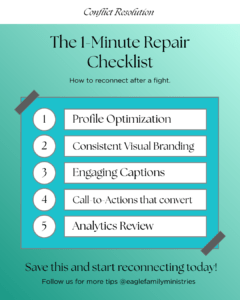
The 1-Minute Repair Checklist (screenshot this)
Progress, Not Perfection: One Step Back to Each Other
If repairing after conflict feels awkward, that is normal. Repair is a skill, and skills get easier with practice. You do not have to do this perfectly. You just have to take one step toward each other.
If you want a starting point, use this one sentence today:
“I love you, and I want to reconnect after a fight. Can we try again?”
Click here for more conflict resolution strategies.
Ready for the Next Step? Let’s Build a Stronger Marriage Together
Are you ready to strengthen your connection? Eagle Family Ministries offers fun marriage retreats, custom-designed seminars at your location, plus marriage and premarital coaching to help you build a healthy, Christ-centered relationship.